Our Location
304 North Cardinal St.
Dorchester Center, MA 02124

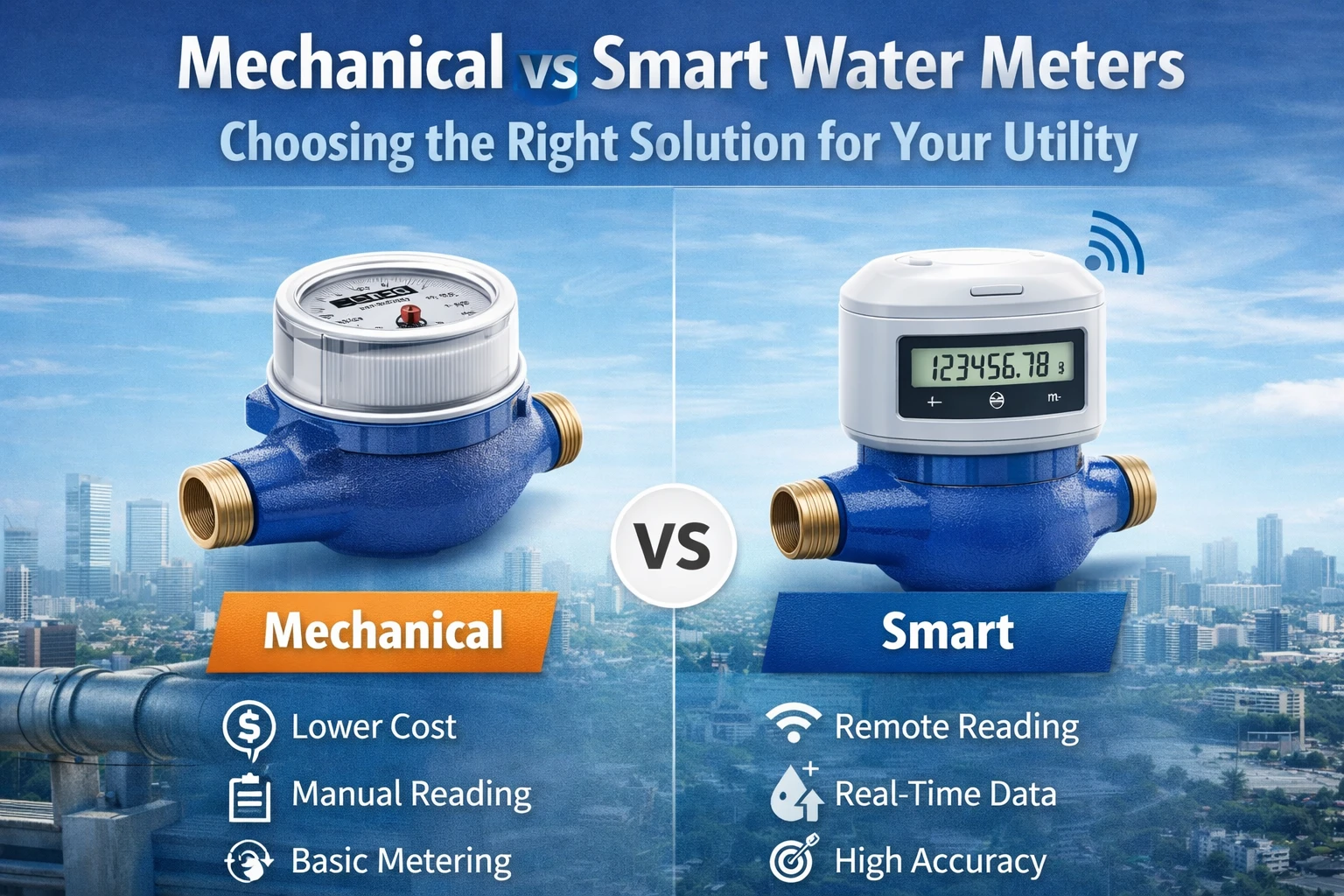
As cities and utilities worldwide work to modernize water management systems, one key question frequently arises:
Should we choose mechanical water meters or smart water meters?
Both technologies play important roles in water measurement, but they serve different operational needs, budgets, and management goals. Understanding their differences is essential for utilities, municipalities, and project developers to make the right investment decision.
This article provides a clear comparison to help you choose the most suitable water metering solution for your utility.
Mechanical water meters measure water flow using moving mechanical components such as a turbine, multi-jet, or Woltmann mechanism. They have been used reliably for decades in residential, commercial, and industrial applications.
Mechanical meters are especially popular in small cities, rural areas, and cost-sensitive projects, where basic water measurement is the primary requirement.
Smart water meters integrate electronic measurement, communication modules, and data management capabilities. They automatically transmit consumption data through technologies such as NB-IoT, LoRaWAN, M-BUS, RS485, or AMI systems.
Smart meters are widely adopted in urban areas, large utilities, and smart city projects, where efficiency, data visibility, and long-term sustainability are priorities.
| Feature | Mechanical Water Meter | Smart Water Meter |
|---|---|---|
| Initial Cost | Lower | Higher |
| Accuracy | Good (may degrade over time) | High and stable |
| Meter Reading | Manual | Remote / Automatic |
| Leak Detection | No | Yes |
| Data Availability | Limited | Real-time or scheduled |
| Labor Efficiency | Low | High |
| Ideal Use Case | Basic metering, rural areas | Urban utilities, smart cities |
The right choice depends on your current challenges and long-term goals:
In many cases, utilities adopt a hybrid approach, using mechanical meters in less critical areas and smart meters in high-loss or high-consumption zones.
Selecting a water meter is not just about hardware—it is about choosing a solution partner.
A reliable water metering partner should be able to:
Mechanical and smart water meters each have their place in modern water management. The key is to align your choice with your operational needs, infrastructure conditions, and long-term development strategy.
By choosing the right water metering solution, utilities can improve efficiency, reduce water loss, enhance billing accuracy, and build a more sustainable water management system.
Not sure which solution fits your project best?
Contact our technical team to receive a customized water metering recommendation based on your utility’s needs.
