Our Location
304 North Cardinal St.
Dorchester Center, MA 02124

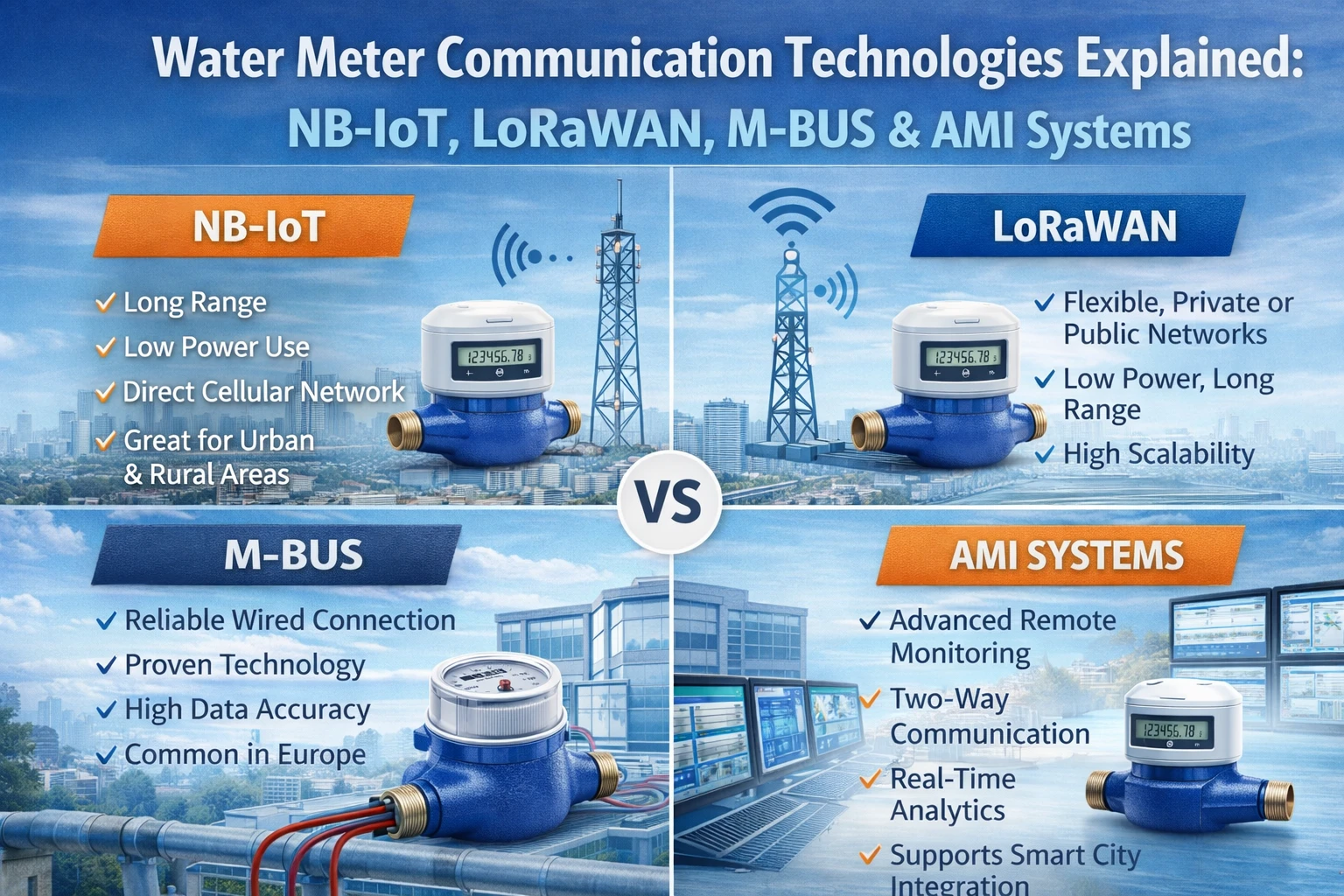
In today’s rapidly evolving urban water management landscape, smart water meters are no longer just about measuring water consumption—they are a critical part of digital water infrastructure. A key factor in their effectiveness is the communication technology they use. Choosing the right communication protocol ensures real-time data collection, accurate billing, leak detection, and efficient system management.
This article explains the most commonly used water meter communication technologies and helps utilities understand which system fits their needs.
NB‑IoT is a low-power, wide-area (LPWA) technology designed for IoT devices, including smart water meters.
NB‑IoT is perfect for utilities looking for long-term, scalable solutions with minimal infrastructure upgrades. It enables real-time water consumption monitoring and helps detect leaks and anomalies efficiently.
LoRaWAN is another LPWA technology that allows meters to transmit data over long distances using private or public gateways.
LoRaWAN is ideal for utilities that want full control of their network and need a cost-effective solution for dense urban or suburban deployments.
M-BUS is a wired communication protocol widely used in Europe for utility metering.
M-BUS is ideal for high-accuracy, wired installations in residential complexes, industrial parks, and municipalities where wireless deployment is difficult.
AMI systems are complete metering solutions combining meters, communication networks, and software for remote reading, monitoring, and management. AMI is not a single communication protocol but an integrated system that can use NB‑IoT, LoRaWAN, or other technologies.
AMI is best suited for utilities pursuing full digital transformation, requiring data-driven decision-making and operational efficiency.
When selecting a water meter communication technology, consider:
Many utilities adopt a hybrid approach, combining technologies based on zone-specific requirements, budget constraints, and operational goals.
Understanding the differences between NB‑IoT, LoRaWAN, M-BUS, and AMI systems is essential for efficient, modern water management. The right communication technology allows utilities to monitor consumption, detect leaks, improve billing accuracy, and reduce non-revenue water (NRW), ultimately contributing to sustainable water use and operational excellence.
Investing in the right water meter communication system is not just a hardware choice—it’s a strategic decision for smart, efficient, and sustainable urban water management.
Are you ready to upgrade your water metering infrastructure?
Contact our team today to explore customized solutions for smart water metering with the communication technology that best fits your utility’s needs.
